The catalog and the buyer
Casters look simple until you have to choose one. A single manufacturer’s range covers swivel and rigid casters, kingpinless rigs, replacement wheels, axles and accessories. Within one wheel family, products differ by diameter and width (6×2, 8×2, 10×3), tread compound (polyurethane, ductile iron, phenolic), hub bore and rated capacity.
The people searching are maintenance engineers, plant managers and procurement teams. They rarely search by product name. They search the way they think about the problem:
- The spec: “5 inch caster with 1,000 lbs capacity”
- The job: “casters for surviving moist environments”, “5 inch caster for working in a blast furnace”
- The part they’re replacing: “wheels for 96-06301-20-1”, “wheels for ergotread casters”
Every one of those is a buying signal. Every miss sends a buyer to a competitor or to the phone.
What went wrong with keyword search
We ran the kind of queries buyers actually type against standard keyword search and against Xearch, on the same catalog, and compared the top results. Two failures show up clearly in the screenshots, and a third is common to keyword engines generally.
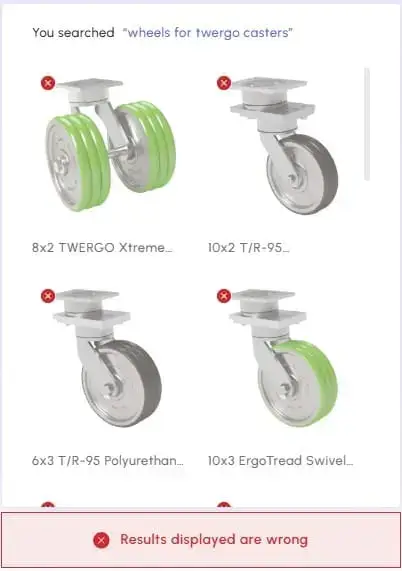
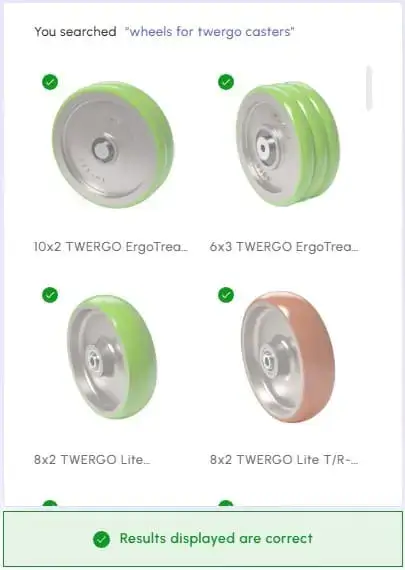
- Words matched, meaning didn’t. Searching for wheels for a caster model returned the complete casters, because the model name matched. The buyer wanted the wheel, not the caster it fits.
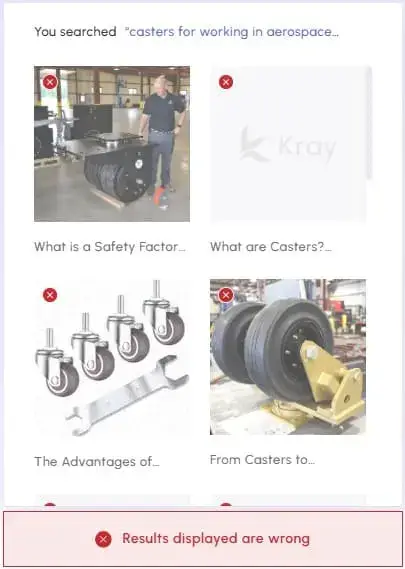
- Content outranked products. Application searches such as “casters for working in aerospace” returned blog posts and news items (“What is a safety factor?”, “What are casters?”), because those pages used the words most often.
- Numbers are treated as text. Keyword engines match “5 inch” and “1000 lbs” against any page containing a 5 or a 1000, including series names, instead of filtering on wheel diameter and load rating. Part numbers that aren’t indexed as words return nothing.
How Xearch was set up
We onboarded the catalog in the same four steps we use for every deployment.
1. Structured product data
The product feed was ingested with every attribute kept as a typed field: diameter, width, tread material, durometer, bore, bearing type, capacity, temperature range and the list of compatible parts. Units were normalised so “5 in”, “5″” and “5 inch” mean the same thing, and capacity can be compared numerically.
2. Product knowledge from the manufacturer’s own content
Catalog PDFs, load tables, application articles and product videos were used to teach Xearch which properties matter in which environment. For example, that washdown areas call for corrosion-resistant materials and sealed bearings, or that furnace work calls for wheels rated well above ambient temperature.
3. Query understanding
Each query is read for three things: hard constraints (numbers and units), the application or environment, and any part number. Hard constraints become filters, so results must meet them. The application becomes a ranking signal drawn from the product knowledge. Part numbers resolve to the product and its compatible parts.
4. Sales handover
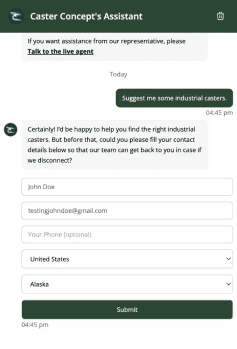
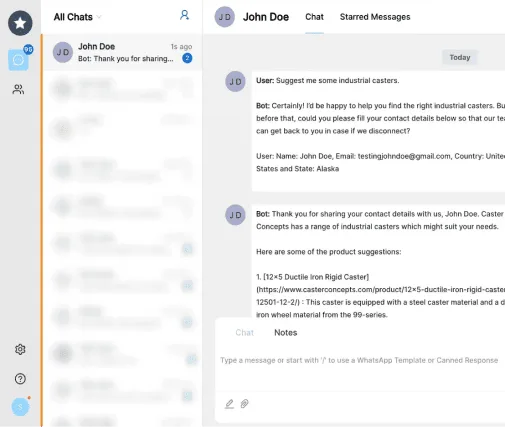
When a buyer asks for help, wants a quote or describes a custom requirement, the assistant collects their name, email, country and state, then hands the full conversation to the sales team’s inbox with the products already suggested.
Results, query by query
The table records the queries captured in the screenshots on this page. “Correct” means the visible results were all products that met the requirement.
| Query | Type | Keyword search | Xearch |
|---|---|---|---|
| wheels for twergo casters | Compatibility | Complete casters returned; marked wrong | Compatible wheels only; marked correct |
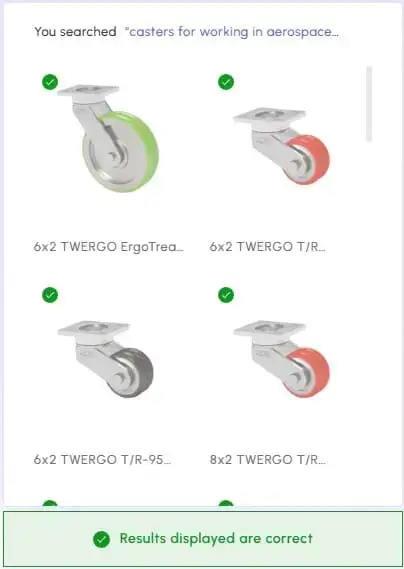
| casters for working in aerospace industry | Application | Blog posts and news items; marked wrong | Casters suited to the application; marked correct |
More queries from the buyer list are loaded in the live demo so you can try them yourself: “hercules caster with 8" wheels”, “5" caster with 1000lbs capacity”, “casters for surviving moist environments”, “5" caster for working in blast furnace”, “wheels for ergotread casters”, “8" wheels for polyurethane casters” and “wheels for 96-06301-20-1”.
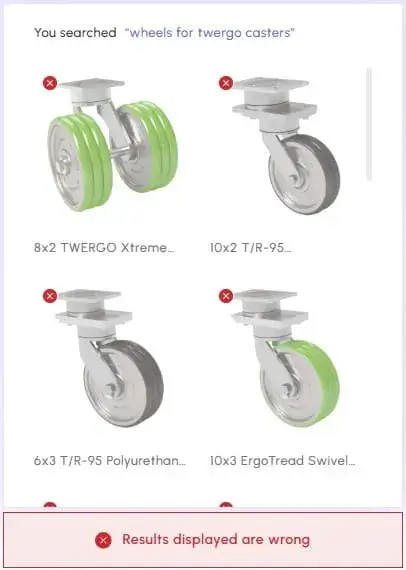
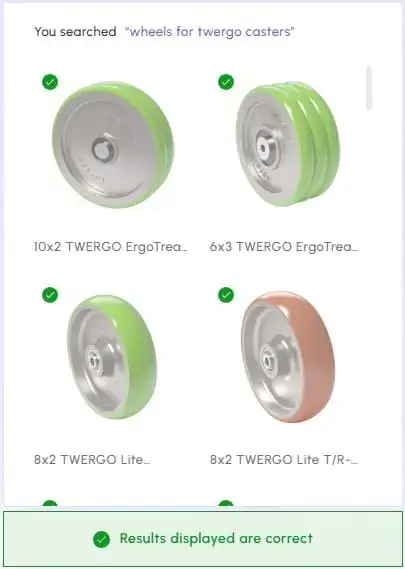
The short version: on the same catalog, keyword search returned the wrong product type or editorial content, and Xearch returned products that met the requirement. Compatibility searches matter most: they usually come from a buyer replacing a worn part who is ready to order.
Handover: the lead arrives with context
Not every buyer should be self-served. Custom load requirements, volume orders and unusual environments still need an applications engineer. Xearch captures the requirement in the chat and delivers it to the sales inbox with the conversation and suggested products, so the engineer can reply with a recommendation rather than a list of questions.
What this means for your catalog
If your products are chosen by specification, environment or compatibility, the castor wheel results will look familiar. A few questions tell you quickly whether search is costing you orders:
- Search your own site for a part number from last month’s orders. Do you get the part, or nothing?
- Search for a spec with a number and a unit. Do the results meet the number?
- Search for an application your sales team gets asked about weekly. Do you see products or blog posts?
If the answers are “nothing”, “no” and “blog posts”, book a call and bring those queries. We’ll run them on a sample of your catalog. You can also try the live demo built on this caster catalog.
Frequently asked questions
Why is a castor wheel catalog hard for site search?
Hundreds of products differ by one or two attributes such as wheel diameter, tread material, bore size or load rating, and buyers describe needs in engineering terms like capacity, floor type or temperature. Keyword search matches words, so it returns near-misses, blog posts or nothing.
Can Xearch find replacement wheels from a caster part number?
Yes. Xearch links each part number to the product it identifies and to the parts that are compatible with it, so a search such as “wheels for 96-06301-20-1” returns the replacement wheels that fit that caster.
What content was Xearch trained on for this catalog?
The manufacturer’s product listings with full attributes, catalog PDFs and load tables, application articles from their blog and their product videos.
Does this approach work for other industrial products?
Yes. The same pattern applies to bearings, fasteners, hydraulic fittings, electrical components, MRO supplies and spare parts: any catalog where buyers search by specification, application or compatibility.
Product names in the screenshots belong to the manufacturer. Screenshots are from the Xearch demo built on the manufacturer’s public catalog. The manufacturer is not named on this page; ask us on a call for more detail.